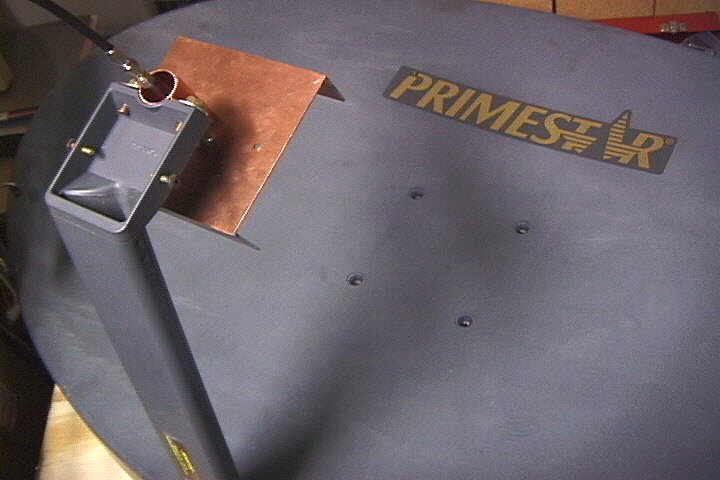
Looks like a Barbie (tm) TV aerial, but it seems to work.
It is based on calculations from the Java applet on
http://fermi.la.asu.edu/w9cf/yagipub/index.html .
I started from one of the examples (70 cm, 12 elem) and scaled it to 2400 MHz as explained. I used 1.5 mm² domestic wire. I drilled small holes in the wood to put the wires in and I glued them in. One can see pieces of matches glued to fix the 'N' connector. I just used 8 elements for a first test because my wooden stick wasn't any longer...
I made two longer ones (66.5 cm, 20 elements). One with domestic electrical tubing (gray) that does not work and another one with a wooden stick (7x7 mm²) that gives me three dB's more (I expected five). Maybe, it is because the wood is thicker? I don't know yet what is important and what is not. What would make a good boom? Is it reproductible?... At first sight, it is easy to build, cheap and gives many dB's.
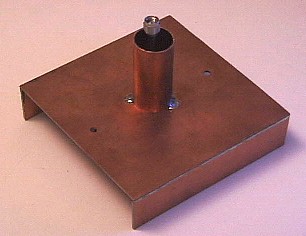
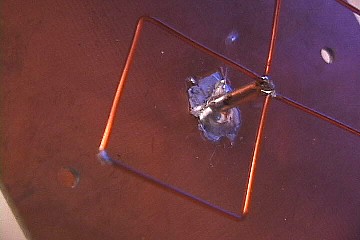
Branislav M. asked me how I did wire the dipole on the 'N-Connector'. Well, it is probably not the way to do... (I should use a Ballun, do it more carefuly,...). But it is the way I did it. And it seems to work (at least with a 2.5 meters pigtail). I have no idea how better it would be if it was 'well' done.
Here is the comparison with other antennae :
Beware of polarization!. It matches a
parallel Marconi (Lambda/4 piece of copper)(all antenna wires in the same plane). Horizontal ones would go well with vertical Slotted Wave Guides (
http://trevormarshall.com/waveguides.htm)
Elem    length     distance (mm)
 1       61           0       (reflector)
 2       60           19      <- driven elem, it is a 'folded dipole'...
 3       56           26
 4       55           40
 5       53           60
 6       53           84
 7       52           112
 8       52           144
 (9      51           178)   (my stick is shorter,
 (10     51           215)       for a first test, it is good enough)
 (11     51           255)
 (12     50           296)
NB: I don't know where to link it on this wiki. If somebody can help. Thanks! (photos are still in Belgium; a local copy would be welcome)
See also :
Elem    length     distance (mm)
 1       58           0       (reflector)
 2       53.5         20      <- driven elem, it is a 'folded dipole'...
 3       52           35
 4       51.5         50
The wire is 0.8 mm brass (model-making)
Another crazy idea is to use
Tetra Brik (Milk or Juice carton) as a wave guide antenna. It contains enough aluminium to reflect waves. See
http://ReseauCitoyen.be/?BoiteDeLait . It is also easy to add a
horn and get more dB's.

Lg = 1 / SQRT(1/(L0*L0) - 1/(Lc*Lc))
and Lc = 2 * width
width is here 9.5 cm -> Lg is ~16.6 cm at L0=12.5 cm (2400 MHz); The rod is thus at ~4 cm from the bottom of the brick. The rod is Lambda/4, about 3 cm. It is 'fragile', but so easy to build... (and you can already go far away, probably more than 2 km with two of them).
For the skeptics, I just ran some tests. I compared my antennae about 30 meters away from a (vertical) Lambda/4 inside my apartement (it goes through a window and there are a few tree leaves in the path, so don't extrapolate the distance).
Ups and downs show the polarization effect (vertical/horizontal). This (short) Uda-Yagi is the best :-). Of course, a longer one will still be better.
*Note: The Yagi-Uda provides an object lesson in the importance of good communication skills. This antenna was invented in the early part of the 20th century by a pair of Japanese engineers named Uda and Yagi. Uda san was the brains of the operation and had the key idea, but had very limited english. Yagi, however, was fluent enough in english to take care of the publication. As you've seen, he has been immortalized (at least among radio weenies), while Uda languishes in obscurity.) (
ref)
NOTA COMPLETA 


 hi
hi 


 El Reflector1 es un círculo de 123mm de diámetro de chapa de latón de 0.5mm de espesor. Se marca con compás o plantilla y se corta con la tijera para chapa. En este reflector hacemos dos agujeros, uno con centro a 26mm del centro del reflector, y de 12mm de diámetro, en este agujero soldaremos el mástil. Hacemos otro agujero, de 4mm de diámetro y con centro a 18mm del centro del reflector. En este agujero soldaremos un trozo de tubo de latón de 4mm de diámetro y de 60mm de longitud. Por el interior de este tubo se introduce el cable coaxial RG-316, soldamos el cable coaxial al Alimentador y en el otro extremo del cable le colocamos el conector apropiado, dependiendo a que aparato Wifi vayamos a conectar la antena.