Buscar este blog

Mostrando entradas con la etiqueta Free. Mostrar todas las entradas

lunes, 13 de junio de 2011

25 lemas para una revolución

25 lemas para una revolución
Una selección de los lemas, las frases y las pancartas surgidas de las protestas que se iniciaron el 15M, que más han llamado la atención a los ciudadanos
1. "No somos antisistema, el sistema es anti-nosotros"
2. "Me sobra mes a final de sueldo"
3. "No hay pan para tanto chorizo"
4. "¿Dónde está la izquierda? al fondo, de la derecha".
5. "Si no nos dejáis soñar, no os dejaremos dormir".
6. "Se alquila esclavo económico"
7. "Se puede acampar para ver a Justin Bieber pero no para defender nuestros derechos"
8. "Error 404: Democracia not found"
9. "Error de sistema. Reinicie, por favor"
10. "Esto no es una cuestión de izquierda contra derechas, es de los de abajo contra los de arriba"
11. "Vivimos en un país donde licenciados están en paro, el presidente de nuestro gobierno no sabe inglés...y la oposición tampoco"
12. "Mis sueños no caben en tus urnas"
13. "Políticos: somos vuestros jefes y os estamos haciendo un ERE"
14. "Nos mean y dicen que llueve! "
15. "No falta el dinero. Sobran ladrones"
16. "¿Qué tal os va por España"?- Pues no nos podemos quejar. O sea, que bien ¿no?- no, que no nos podemos quejar."
17. "No es una crisis, es una estafa"
18. "No apagues la televisión... Podrías pensar"
19. "!!Tengo una carrera y como mortadela!!"
20. "Manos arriba, esto es un contrato"
21. "Ni cara A, ni cara B, queremos cambiar de disco"
22. "Rebeldes sin casa"
23. "Democracia, me gustas porque estás como ausente"
24. "Nosotros buscamos razones, ellos victorias"
25. "Cuando los de abajo se mueven, los de arriba se tambalean"


SI ESTAS DE ACUERDO , DIFÚNDELO

SI HAY QUE CORTAR... CORTEMOS

En Bélgica llevan casi 1 año sin gobierno y estan en la gloria, EL SISTEMA FUNCIONA SÓLO CON UNAS BUENAS Leyes


España debe bajar su déficit en 9,4 puntos porcentuales en la próxima década, una de las reducciones más drásticas del mundo, según el Fondo Monetario Internacional... que además pide un recorte en las prestaciones sanitarias de nuestro paí­s para reducir la deuda. Menudo panorama.

¿No crees que ha llegado el momento de coger el toro por los cuernos?...


ELIMINAR EL SENADO. NORUEGA, SUECIA, DINAMARCA, NO TIENEN SENADO, ALEMANIA SOLO 100 SENADORES, EE.UU. UN SENADOR POR CADA ESTADO. LOS GRANDES TEÓRICOS DEL DERECHO INTERNACIONAL Y CONSTITUCIONAL (DUVERGER, JELLINEC, ETC.) OPINAN QUE ES UNA CÁMARA INNECESARIA, PRESCINDIBLE Y QUE ESTÁ EN EXTINCIÓN, ¿ENTONCES POR QUÉ TENEMOS QUE MANTENER A 260 SENADORES? DE ESTA FORMA AHORRAREMOS 3.500 MILLONES DE EUROS CADA AÑO.

ELIMINAR LA PENSIÓN VITALICIA DE TODOS LOS DIPUTADOS, SENADORES Y DEMÁS "PADRES DE LA PATRIA ".

REVISAR LOS SUELDOS DE ESTOS ALCALDES QUE SE PONEN LOS SUELDOS QUE LES DA LA GANA.

CAMBIAR LAS LEYES, Y ADEMÁS DE CÁRCEL PARA LOS LADRONES, OBLIGAR A QUE TODO EL DINERO QUE HAN ROBADO LOS POLÍTICOS Y DEMÁS "ADJUNTOS" VUELVA A LAS ARCAS DE DONDE HAN SIDO ROBADO. Exalcaldes, novias de estos exmujeres etc, hijos y familiares de politicos y secuaces.
ELIMINAR los coches oficiales (no es posible que tengamos más coches oficiales que USA).

Anular TODAS las tarjetas de crédito oficiales (que cada uno pague con la propia) y poner en la calle a TODOS los "cargos de confianza" (tenemos funcionarios de sobra para encargarse de esas labores).

ELIMINAR A TODOS los diplomáticos excepto un embajador y un cónsul en cada paí­s. (No es posible que gastemos en esto más que Alemania y Reino Unido).

Con eso, y con rebajar un 30% las partidas 4, 6 y 7 de los PRESUPUESTOS GENERALES DEL ESTADO (transferencias a sindicatos, partidos políticos, fundaciones opacas y varios) se ahorrarí­an más de 45.000 millones de Euros, no harí­a falta tocar las pensiones ni los sueldos de los funcionarios, ni subir el IVA, como tampoco harí­a falta recortar 6.000 millones de Euros en inversión pública.


Tiene razón el FMI cuando dice que "un buen plan de ajuste podrí­a incluso acelerar la actividad económica".

CON LA MITAD DEL DINERO QUE EL ESTADO SE AHORRARÍA CON ESTAS MEDIDAS, SE ACABARÍA LA CRISIS EN ESPAÑA


PASADLO A TODOS VUESTROS CONTACTOS Y QUE CORRA LA VOZ.

LA DENUNCIA SILENCIOSA


Está comprobado que los millones de msn, correos, vía móvil e Internet ha logrado exasperar a los políticos de este país.

Hay que seguir denunciando y dar curso a todos estos mensajes que les pongan en evidencia.

jueves, 2 de junio de 2011

Propuesta entregada a la Asamblea General 15M (Democracia Real Ya) para su estudio

1 Estudio de la experiencia de igual sustitución de SO privativos a SO Libres de otros países y administraciones.

2 Implantar a nivel Estado Español, Autonomías, Provincial y Ayuntamientos del uso y promoción del Sistema Operativo Linux y el Software GNU/Linux.

3 Crear puestos de trabajo docente y programación en entornos GNU/Linux para la migración.

Documentos a consultar:

www.links.org.ar/weblinks/linux-adminpub.pdf

http://www.buenastareas.com/temas/linux-en-la-administraci%C3%B3n-publica-nacional/400

http://youtu.be/iZ3V2j9uCnY

Consultas o aportaciones currolinuxero@gmail.com

martes, 10 de mayo de 2011

Antena Parabólica para 2.4 ghz

Antena Parabólica para 2.4 ghz


Luego de haber divagado bastante con el tema de mi antena, me incliné por hacer el modelo parabólico. Esto se debe a que tuve la suerte de conseguir un disco de TV satelital de 80cm ;).  Con respecto al disco, puede ser también uno de DirectTV o de SKY (aprovechando que se tomaron el palo de nuestro benefactor país )

Lo primero que hice fue buscar qué poner el foco de la parábola como "iluminador". Luego de varias búsquedas elegí la guía de onda que era lo más fácil de hacer y a su vez daba buenos resultados.
Nota: Lo ideal para este caso sería una biquad, pero me resulto medio complicada de hacer.

La guía la hice siguiendo estas instrucciones, pero adaptándola a las medidas que de mi tarro. (tarro de aceite mazola). Las medidas para hacer la guía con el tarro de aceite mazola son:


Frecuencia
2.422 Ghz
Diametro 83mm
Lo 123,86
Lg 255,63
Lc 141,59
Lg/4 63,90
Lg3/4
191,72
Lo/4
30,96


No se en qué estaba pensando cdo elegí la freq, ya que no es la que estamos usando en nuestra red, pero buej!.. el daño ya está hecho.

Todos estos calculos estan hechos para el canal 3 cuando debieron ser para el canal 6.. oouuuch...


Luego, para proteger la guia de onda, use un caño de PVC de 10cm de diámetro con dos tapas. (foto1,foto2) .

Por dentro se ve asi (foto1,foto2)

Soporte

El soporte para sujetar la guia de onda, se lo hice con una moldura de aluminio que secuestré de una heladera vieja que había en mi casa!  ;) y el fleje central de un patin lecsese viejo 8) . Es importante lograr algún diseño que nos permita luego ajustar la antena con cierta precisión y que permanezca en su lugar pese al viento y la lluvia.


Finalizando

Una vez colocado el tarro en el soporte de la parábola, estaría lista para apuntarla.


Nótese la inclinación que lleva, esto es así porque el foco en esta parábola no se ecuentra en el centro, sino mas hacia abajo. Otro dato a tener en cuenta es que ésta antena (en la foto) está apuntada a un cerro que mide 1000mts desde el suelo. Si tuviesemos que apuntar a un lugar más nivelado, debería estar mas inclinada hacia abajo aún.

Cualquier duda que tengas sobre los conceptos volcados en ésta page consultame a <lu7mra at qsl.net> , para todo lo demás existe Gooooooogle  ;).

nota completa 

lunes, 9 de mayo de 2011

Trevor Marshall BiQuad 802.11b Antenna 11dBi, wide band

Trevor Marshall


BiQuad 802.11b Antenna

11dBi, wide band


Some of Trevors test equipment

***Engadget builds and tests a BiQuad/Primestar combination ***
Click here for details of Mark LaPierre's 1100ft link through forest canopy, and comparison with Pringles can performance.
Click here to link to Koen Weijand's page on using an 18inch dish and feed details
Link to my tutorial 'Antennas Enhance WLAN Security' from BYTE.com, October, 2001
Click here to read about the High Gain (15-17dBi) Slotted Waveguide WLAN antennas
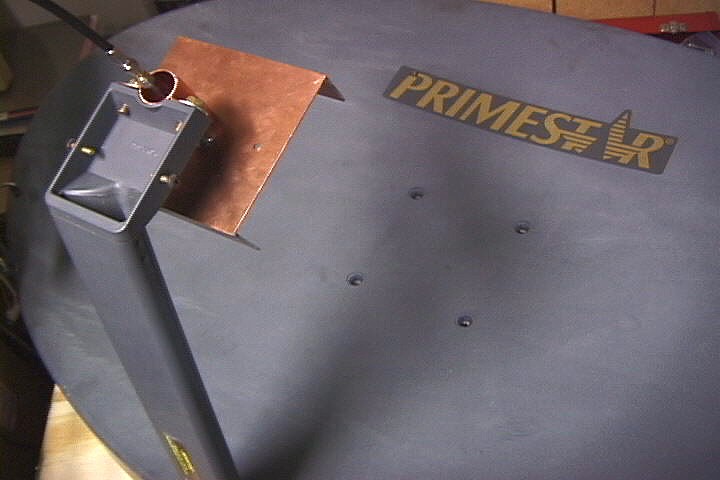
Low sidelobe 802.11b BiQuad feed for Primestar dish
The Primestar dishes are high gain, low cost, parabolic reflectors with an offset feed. They have superior sidelobe performance when compared with a wire grid antenna, reducing the chance that somebody off of the axis of your link will be able to interefere with it. But they are hard to feed because the f/d ratio varies from about 0.5 in the vertical axis to 0.8 on the horizontal axis.
Additionally the spacing between the feed 'slot' and the feed mounting bar is small (about 55 mm), which is less than a half wavelength at 2.4GHz
Failure to couple efficiently to the dish's wide aperture, or to minimize radiation into the mounting bar, will result in poor gain and/or significant sidelobes.
The feed is oriented for vertical polarization in this photo. To make it horizontal merely rotate the feed by 90 degrees. You will lose about 3dB of gain when using the horizontal mode, as the biquad's radiation pattern is a better match for the dish's oblong shape when vertical polarization is used.
Primestar Dish with Biquad Feed in vertical polarization mode

Construction of the Biquad
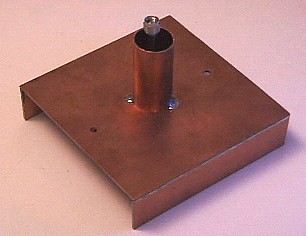
I used Printed Circuit board scraps for the 110 x 110 mm reflector, but it will be just as effective if made out of sheet brass or copper. Aluminum can be used if soldering of the rigid coax is not required at the feed point.
The reflector's 'lips' are 30 mm high, and serve to reduce coupling into the mounting bar. Note that they are only required along the main edge axis of the reflector. The lips cut down radiation from the rear lobes of the biquad by about 6 dB
The best SWR is obtained when the biquad loop is about 15mm above the ground plane, and the SWR may be adjusted by varying this distance.
If you are making a stand-alone antenna, rather than a feed, you will get better gain from a reflector 123 x 123 mm
The front view of the feed

A piece of 3/4 inch copper piping makes a tight fit with the mount supplied on the Primestar dish
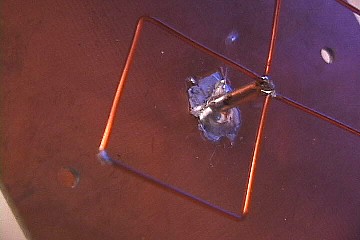
The rigid 0.141 diameter coax is soldered to the groundplane to provide physical support for the structure. If the biquad element is constructed carefully there will be no component of radiation along the axis of the coax, no current is induced into the coax outer conductor, and a balun is not needed.
An SMA connector can be seen on the end of the rigid coax used to support the biquad element
Rear, showing mounting tube

To make the element take a piece of 1.2mm bare or enamelled copper wire exactly 244 mm long. Bend it in half, and then make the bends at the halfway point on each leg (where the solder joints will be). Then bend the 4 remaining right angles so that the element sides are rectangular, and there is about a 1.5mm gap for soldering to the feed. The widths of the two quad elements will be approximately 30.5mm, from wire center to wire center.
You may use standard coax cable to connect at this point, if you do not have rigid cable available, but you will have to figure out how to support the loop physically.
The best SWR is obtained when the loop is about 15 mm above the ground plane and when the reflector is mounted about 10mm in front of the Primestar's feed bracket.
Detail of the rigid coaxial cable soldering


That's all there is to it, folks -- you now have a dish with 27-31 dBi of gain and negligable sidelobe radiation (<40dB). The beamwidth is about 4 degrees.


Biquad visualized with 4NEC2 Look at NEC2.org for information on simulating the performance of the stand-alone Biquad
BiQuad Antenna for PCS CELLULAR Radio
Need a little bit more range for your cellphone? You can make a Biquad for 1900 MHz exactly the same as the one above, but start with a 304 mm long pice of wire, fold it into 8 arms approximately 39.5 and 38.5 mm long. The ground plane needs to be a little larger, use one about 160 mm (6.2 inches) square. If you don't have a coaxial RF input jack on your cellphone you can couple the signal into its existing antenna using a single quad as a matching stub. It's not perfect, but in practice it works well. Solder an alligator clip to either of the high voltage apex (39mm from the feed) of a single 152 mm loop, and clip that to the antenna stub you are currently using. Now you can put 100 ft of coax between your phone and use a roof antenna (the BiQuad) to operate even in fringe areas.

Link to my article 'Antennas Enhance WLAN Security' in BYTE.com, October, 2001

DISCLAIMER: Any resemblance between the above views and those of my employer(s) are purely coincidental. Any resemblance between the above and my own views is non-deterministic. My existence can be challenged. The question of the existence of views in the absence of anyone to hold them is left as an exercise for the reader. The question of the existence of the reader is left as an exercise in the second order coefficient.

All information published at this website is (C)Copyright 1995-2001 Trevor Marshall.
All rights are expressly reserved. Click to email webmaster onepixel.gif - 0.2 K onepixel.gif - 0.2 K onepixel.gif - 0.2 K onepixel.gif - 0.2 K onepixel.gif - 0.2 K
 NOTA COMPLETAonepixel.gif - 0.2 K

miércoles, 4 de mayo de 2011

Recopilacion antenas Caseras

Para el FLISOL Madrid del proximo año 2012 hay una propuesta de estas que son de manitas ! Hacer un taller artesanal ?!?!?!? si un taller tipo hagalo usted mismo para que el concepto del GNU este mas claro ... jajajajaja XD
Aqui van a manera de modelos y sugerencia esta recopilacion !

Y la comparación por excelencia: Stella Doradus vs Babuyaga (by panista)

        
Para este modelos añado 2 imágenes que os ayudaran a fabricarla.


Fuente: www.pe2er.nl


Sección exclusiva donde encontraras todos los manuales para la fabricación de antenas caseras: Manuales fabricación antenas caseras